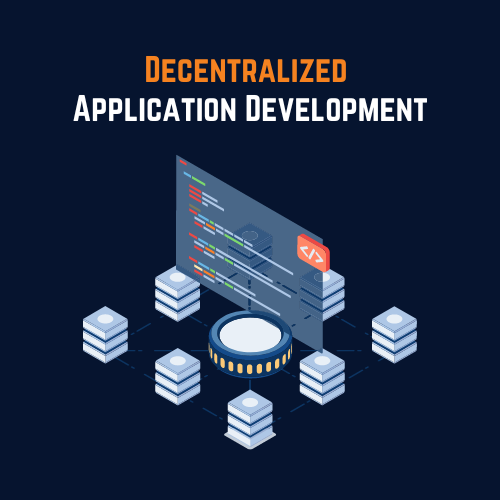
Decentralized applications, or dApps for short, are applications or software that operate on a blockchain network. The apps we usually use run on centralized networks under an “authority.” Due to running on a blockchain or a peer-to-peer network, no centralized authority controls the application, making it decentralized. With rising concerns over privacy and information security, dApps may be the future of technology.
Why you should go with Us
We at Nascenia, strive to stay at the forefront of new technologies. We pride ourselves on being technologically agnostic, utilizing only the best development methods for the benefit of our customers. With a possible paradigm shift on the horizon with new crypto and blockchain technologies, Nascenia is at your call providing you with the following services.
DApps Development services
Here are the services provided by Nascenia regarding dApp development.
dApp Consulting
No project can properly start without consultation with the right people. Nascenia has veteran developers at our wing creating projects over decades, and adapting to a rapidly changing software environment. We also have fresh blood in our roster bringing in new ideas and keeping our workflow constantly changing. Our team can provide you with different insights and perspectives that can help you decide the best course of action for your project. Take advantage of our free consultation today to get started!
dApp Design
Our dApp designers are experienced in designing major functionalities based on blockchain networks. We design our products with keeping user testing in mind, to ensure only the best and intuitive interfaces for the end-users. Our blockchain experts will employ all the tricks up their sleeves to design the best app for you and your customers.
dApp Development
Our developers will create the best, highly customized decentralized apps that will benefit you and your organization as per your requirements. Efficiency, user-centric security, and data transparency are guarantees of our services.
dApp Integration
If you have existing systems, our team can integrate cutting-edge blockchain technologies to bring them up to speed according to your new requirements. They will utilize reusable code and data storage to make them work the same across any OS.
dApp Testing
Our QA team is experienced in testing and finding bugs across a wide range of software, including decentralized applications. We will rigorously test the application to find any underlying issues and ensure optimal performance according to user test data.
dApp Maintenance
Don’t think we will be gone the moment we hand over the software to you. We will be with you afterward to provide support and maintenance. Users are bound to run into issues, and we will provide all the help you need to deal with them. With how new decentralized apps are in the world, new updates and regulations keep coming that require updates. We will be with you for the maintenance of your applications.
Blockchain Technologies for decentralized applications
These are some of the popular technologies used to develop decentralized apps.
Ethereum
Ethereum is a blockchain-based computing platform that can be used for the development of decentralized software. Some of its popular features are smart contracts, Ethereum virtual machines, decentralized autonomous organizations (DAO), and of course, decentralized apps. It is currently one of the more popular for dApp development.
Solana
Solana (SOL) is a blockchain platform that can host scalable, decentralized apps. One of Solanas unique propositions is its speed of use. It can handle trades in a very short time, an advantage over most of its competition. It also provides features such as smart contracts and proof-of-stake(PoS) consensus mechanisms.
Polygon
Polygon is a dApp dev tool known for its wide range of features. Developers have the option to customize their dApp to whatever fits their needs. They can even prioritize one feature over another to best suit their app’s purpose. One of its most notable features is Ethereum compatibility. Other than that, it provides features such as high scalability, security, interoperability, modularity, and many more.
Avalanche
Avalanche is a popular tool to create DeFi (decentralized Finance) dApp known for hosting some of the most high-volume trading platforms. It is known among developers for its ease of use, helping them create dApps in very short development life cycles. Avalanche is known to go head to head with it competitor dev tool Ethereum.
SUI
SUI is a blockchain tool rising in popularity due to its unique blockchain architecture and PoS consensus mechanism. Their own selling pitch is “Benefits of Web3 with the Ease of Web2”. Its apps are known for a high volume of transactions in milliseconds, making it popular for DeFi. Its unique features, zkLogin, zkSend, and kiosk make it a very secure backbone, allowing for a lot of people to jump into commerce platforms built with it.
Benefits of decentralized applications
You may be asking yourself, ‘Why should I go for a decentralized app when the usual apps work just fine?” To get an answer to this question, let us look at some of the benefits of decentralized applications.
Security
As we have learned, dApps are built on blockchain technology, making it one of the most secure arrangements for data and sensitive information. Blockchain uses cryptographic encryption to make data impossible to change. As a result, all information in a decentralized app will always be authenticated, making it difficult to make alterations to them.
Control
Due to operating on decentralized networks, you do not have to rely on third parties to handle different sections of your app, most notably financial operations. Finances require an intermediary like a bank to facilitate transactions between parties, who control the terms and conditions of the transactions, and will even take charges for their services. With decentralized apps, the whole process is under your control, giving to full access to financial decisions, not to mention, saving you the cost of the service charges of a bank or a financial institute.
Accessibility
DApps do not have to abide by the general laws of internet service providers. So anyone with an internet connection from anywhere in the world can access dApps without requiring to abide by a lot of regulations. As a result, the accessibility of dApps is higher than centralized apps, allowing you to reach out to a larger audience who can participate in your programs without any restrictions.
Transparency
Admittedly, no regulations mean there may be trust issues with decentralized networks as they do not fall under traditional online environments vouching for their credibility. However, due to the transparency of these apps, Blockchain programs provide access to transparent records of transactions, allowing users to verify information before they can move forward with using the app.
Difference between decentralized and centralized apps
Most “usual” apps we use can be called centralized apps. With the introduction of decentralized apps, this distinction has become necessary, especially with the growing popularity of dApps.
A centralized app is created by an owner, which is hosted on one or more servers of the said owner. The apps are “copied” by the users, giving them access to its features. Every interaction within the app by the users are handled by the owners through their servers. You can think of the owners to be the mediators of the app, handling how users interact with their apps.
Decentralized apps remove this “owner” aspect of software by establishing it on a blockchain or peer-to-peer network. Interactions between users occur directly, with no middleman server involved. DApps are either free to use or require that you pay the developer in cryptocurrency to gain access. Transactions in dApps utilize something called a “Smart Contract”, which ensures both parties will hold up their end of the contract, removing the matter of trust in a transaction.
Industry-Specific Use-case of DApps
Here are some industry-specific solutions of dApps that are coveted for them.
Financial services
DApps are a great medium for financial transactions as we have already discussed. It is a safe and secure way to exchange currencies or assets without risk of interventions like security and hacking breaches.
Supply chain management
DApps are great tracking tools, making them excellent for supply chain management. This will ensure transparency and accountability when running day-to-day operations.
Identity verification
Due to how blockchain technology allows for no alteration of stored data, identification information cannot be forged, making it a reliable verification tool.
Database management
DApps are already utilized in various industries for their database management capabilities. As we discussed, data manipulation is not something to be worried about in dApps, making it a great data management tool.
Market predictions
Decentralized apps are popular for creating predictive models for different markets, allowing users to make investment and betting decisions on any event.
How your organization can benefit from using DApps
Now that you know about dApp itself, let us look at how it can benefit you and your organization.
Automation
The use of smart contracts ensures that transactions are done with all parties involved holding up their end of the bargain. As a result, a lot of processes and operations can be automated, removing a lot of paperwork and general busywork.
Transparency
With transparency being a huge selling point of dapps, everyone will have access to all the necessary information at all times. This will remove a lot of time spent finding and verifying data needed, streamlining the workflow.
Privacy
Certain blockchain protocols are usually set in motion that hide personal information. So dApps can handle privacy issues pretty well, especially considering the difficulty of hacking them.
Fault-tolerance
By utilizing dApp development, you can remove certain points of failure in your business plans, making them more reliable with more fine-tuning.
Impact of dApp on Various Industries
Here are some of the industries dApps are being used and standardized.
- Blockchain – With blockchain being the basis for dApps, it has been adopted as the standard by most blockchain companies.
- Fintech – The reliability and lack of intermediaries make dApps a lucrative business opportunity for most Fintech companies. They are slowly moving towards dApps due to the full control and accountability they grant these companies.
- Healthcare – We mentioned how dApps provide great data management properties, with secure and non-alterable data. With how important data is for healthcare, it is being used by a lot of professionals and institutions in this industry.
- Real Estate – Real estate business deals with huge databases and large transactions between clients. As a result, dApps fits right into the general activities of the real estate business. Reliable distributed ledger and safe transactions of large amounts of assets is making dApps a must-have in the industry.
- Logistics – With great supply chain management features, dApps are perfect for logistics
- Pharma – Similar to real estate and health care, the pharma industry deals with huge databases and cash transactions, especially with hospitals. A lot of pharma companies are using dApps to handle deals and data for their security and reliability.
- Insurance – Another industry that deals with databases and huge transactions, insurance companies are using dApps to keep track of clients and their spending. Here is a list of decentralized Insurance dapps that you can check out right now.
- Digital identity – With the help of AI and dApps un-alterable databases, they are used to maintain the digital identity of required personnel utilizing and trading on these apps.
Some examples of decentralized apps
Verse Dex
Verse Dex by Bitcoin.com is a decentralized exchange (DEX) where users trade cryptocurrency without any third-party involvement. Users have full control over their finances and can verify who they trade with. Verse Dex allows for the trading of a diverse range of cryptocurrencies, allowing users to show off their expertise and trade with both popular and niche currencies. Users have the opportunity to greatly diversify their portfolio to their knowledge to maximize return on investment.
Uniswap
Uniswap is a decentralized cryptocurrency exchange platform built on Ethereum. Trades are performed through the use of AMM smart contracts, which administer the pools where users pay their tokens. These unique tokens are known as UNI, which are used for trading. Uniswap’s AMM algorithm studies the market and trading to determine the best token price based on supply and demand.
Polymarket
Polymarket is a decentralized information market that allows the trading of real money markets based on popular current events. Here, participants trade with what is known as an “Outcome Share”, which can redeemed for 1 dollar based on its deemed accuracy. The objective of this app is to gather people’s collective knowledge and a general prediction of what is to come by using the power of free markets.
Trader Joe
Trader Joe is a decentralized trading platform built on Avalanche that facilitates high-volume asset trading. It utilizes its own Joe tokens for exchange, hosting over a hundred unique avalanche-based products. It provides a unique zap feature that allows the conversion of tokens to liquidity provider tokens without having to manually trade them with other users.
So, what are you waiting for? With the vast potential and possibilities presented with dApps, it is best to jump right into them. DApps have the possibility of becoming the future standard, and with our guidance, you can be one of the first entities to embrace this technology.
Challenges faced by decentralized apps
With all the potential dApps have, we need to keep in mind that it is still a relatively new technology. While cryptocurrency and blockchain technologies are slowly becoming mainstream in the tech world, it is still a long way from being the standard used by everyone. It is still in its experimental phase, which will take time to develop standard practices that can be widely used by everyone.
Another challenge that dApps need to face is a lack of intermediaries. Now, in most cases, a lack of regulation from third parties is a good thing, but you need to understand that those third parties are responsible for making sure your trades and trading partners are legit. Now that responsibility for verification falls on you. This issue can be mitigated by being more thorough and vigilant about who you trade with. Be careful as a lack of regulations can attract a lot of “opportunistic” people to put it nicely. Do your research to avoid getting scammed.
More to Explore
The Quest for Knowledge Continues. Fuel Your Curiosity.