The Hidden Goldmine Every Online Store Owner Overlooks
Picture this: you spend $200 to get a new customer through ads. That money disappears if the customer buys once and never comes back. It’s a loss you can’t ignore, especially when your competitors are quietly making more by keeping those same customers.
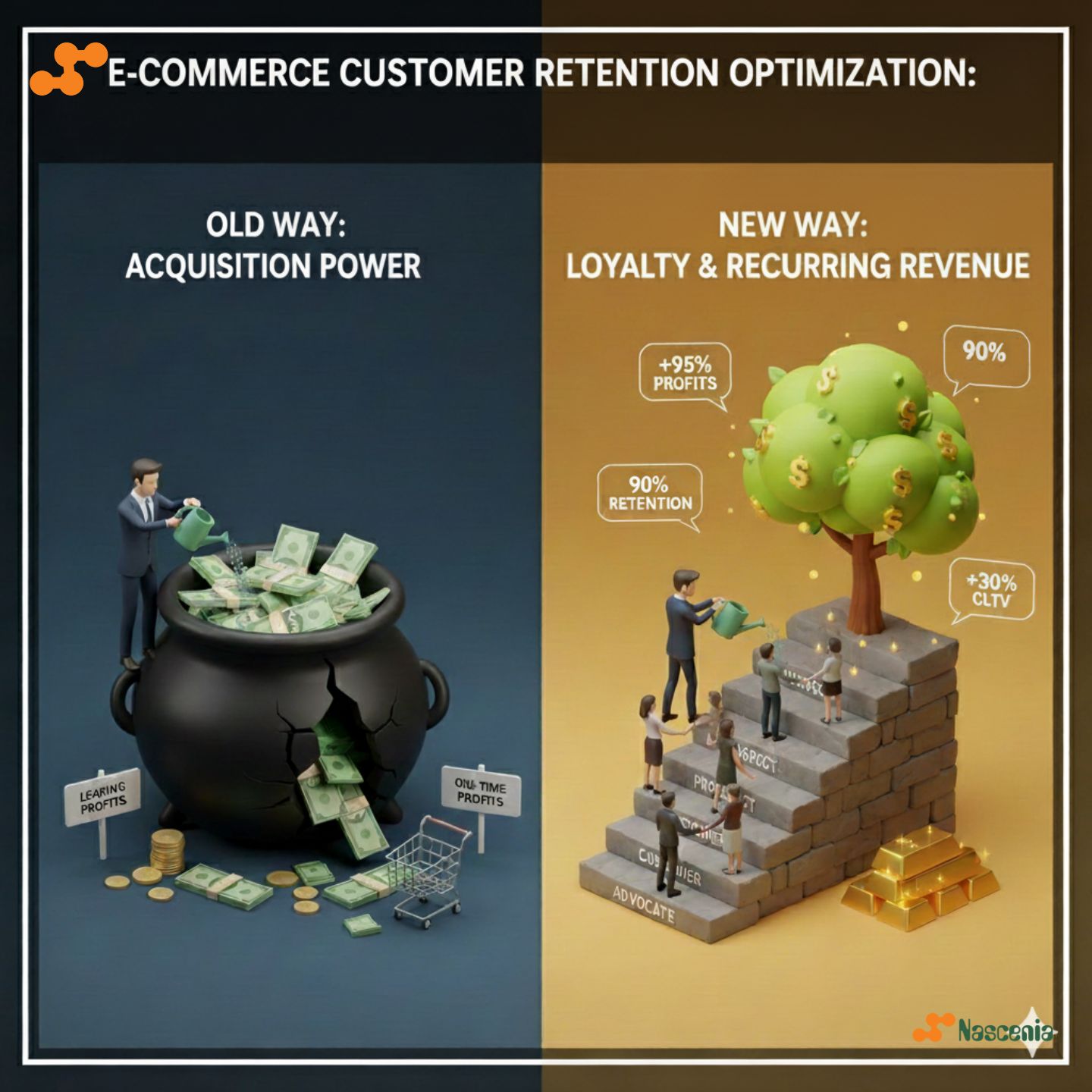
Here is the uncomfortable truth: Most e-commerce companies are losing. They are fixated on customer acquisition and are pouring more and more money into ads and incentives to get new customers. Yet, they are ignoring the goldmine that is right under their noses—their existing customer base. The brands that are winning aren’t the ones that are bringing in the most new shoppers. They are the ones who have been successful at transforming their infrequent shoppers into faithful, nearly missionary customers.
So, let’s look at customer retention. Your biggest wins come from building strong relationships with the customers you already have, not just chasing after new ones.
Decoding Customer Retention: Beyond Basic Definitions
Improving customer retention isn’t just tracking repeat purchases. It means understanding every interaction and experience that makes customers want to stick with you. I call this building strong relationships.
A partnership forms the basis of a relationship with a customer. It is a partnership that requires work from both sides to form a bond that is sustainable, rewarding, and worth the effort. Think of this as a ‘loyalty ladder,’ where customers ascend through various stages: suspect, prospect, customer, and advocate. Each stage requires nurturing and engagement to elevate the customer to the next level. If we want to keep our customers, we have to keep courting them.
Getting a new customer is quick, but keeping one takes time and effort. It means understanding what makes people loyal and happy, and why long-term relationships matter. Top retailers know loyal customers are their most valuable asset. When you focus on these customers, your business can grow in ways that are hard to even measure.
The Economics That Will Change Your Business
Here are some revolutionary statistics. Raising customer retention by a mere 5% can boost profits between 25% and 95%. Customers who come back to shop generate 40% of a store’s annual revenue, yet those same customers only account for 8% of the store’s traffic. (“Repeat Customer Statistics: Market Data Report 2024”, 2024)
source → link
The Net Promoter Score (NPS) is also very instructive. A 10-point increase in the NPS often correlates with a 30% increase in Customer Lifetime Value (CLV). (“Leveraging NPS to Elevate CLTV”, n.d.) And that’s not counting the monetizable impact of all the good word of mouth that the store’s customers are now generating.
However, immediate cash benefits only scratch the surface.
Loyal customers follow predictable buying patterns, decreasing the risk that you will over- or under-stock items. They provide feedback that, while sometimes too sparse or too late to be helpful, is nevertheless the most valuable you can receive for product development. Until that day comes when all advertising is as effective as good old-fashioned word-of-mouth, your loyal customers are your best marketing channel.
Essential Metrics: Your Retention Dashboard
Understanding customer behaviour requires tracking the right indicators:
Customer Retention Rate
- The basic measurement you use, showing what part of the customer base comes back to you in certain spans of time.
- Formula: ( Number of customers at end of period – Number of new customers acquired during period ) / Number of customers at start of period ) x 100
- Example: If you began a quarter with 200 customers, added 50 new customers, and closed out the quarter with 230 customers, your retention rate is:
- ( (230 – 50) / 200 ) x 100 = 90%
Repeat Purchase Ratio
- The share of customers who engage in repeat purchasing—your litmus test for loyalty.
- Formula: ( Number of customers with two or more orders / Total number of customers ) x 100
- Example: If you had 100 total customers and 20 of them made at least two purchases, your repeat purchase ratio is:
- ( 20 / 100 ) x 100 = 20%
Customer Lifetime Value
- Maybe the most crucial character, signifying the entire income chance per customer bond.
Simple CLV
- This formula is ideal for a quick and straightforward estimate.
- Formula: Average Purchase Value x Average Purchase Frequency x Average Customer Lifespan
- Example: If an average customer spends \$50 per purchase, buys 3 times a year, and remains a customer for 5 years:
- \$50 x 3 x 5 = \$750
SaaS/Subscription CLV
- This formula is generally used in subscription-based businesses and factors in churn.
- Formula: ( Average Revenue Per Customer per Period x Gross Margin ) / Churn Rate
- Example: If a subscription costs \$100 per month, your gross margin is 80%, and the monthly churn rate is 5%:
- ( \$100 x 0.80 ) / 0.05 = \$1,600
Churn Analysis
- Gaining an understanding of why customers leave gives us actionable insights that we can use to make important improvements.
- Formula: ( Number of customers lost during period / Number of customers at start of period ) x 100
- Example: If you started a month with 200 customers and lost 30 of them by the end of the month, your churn rate is:
- ( 30 / 200 ) x 100 = 15%
Purchase Frequency Patterns
- Unveiling the best times to carry out re-engagement campaigns and doing inventory planning.
- Formula: Total number of orders / Total number of unique customers
- Example: If you had 500 total orders from 200 unique customers in a year, the purchase frequency is:
- 500 / 200 = 2.5 purchases per customer per year
Average Order Value Progression:
- Tracking how spending evolves is tracked across customer journeys.
- Formula: Total revenue / Total number of orders
- Example: If your total revenue for a month was \$31,000 from 1,000 orders, your AOV is:
- \$31,000 / 1,000 = \$31
The Retention Revolution: Strategies That Work
1. Craft Unforgettable Service Experiences
Outstanding customer service isn’t just about fixing things; it’s about creating memorable moments that customers will rave about. View every interaction as a chance to build not just a good but a great emotional connection with your customer. Ask yourself, “Would this interaction earn a 9 or 10 on the Net Promoter Score?” Aim to tip the score upward by incorporating a personal touch into each service moment, such as remembering a customer’s name or past interactions. It’s way healthier and way better for business (not to mention life in general) to treat every service opportunity as an opportunity to surprise and delight than as an opportunity to put out a fire.
Sentiment analysis tools gauge how well (or poorly) a virtual assistant and a human service agent are performing by reading the tone of the conversation. Tools in this category can do a pretty good job of reading tone and, therefore, can describe to us what’s happening in customer service. However, these tools can also do a pretty good job of reading between the lines.
2. Personalisation at Scale
Today’s consumers want customized experiences. They want pathways that are just for them. Use the purchase history, browsing patterns, and the behavioural data of your modern, connected customers to craft individual journeys. Make every touchpoint feel psychographically relevant. Know what makes each customer unique and use that knowledge to create experiences that astound. From content recommendations to psychographic profiling, create an experience that is unfathomably relevant to them.
3. Loyalty Programs That Drive Loyalty
Today’s loyalty programs have evolved from simple point-giving to fostering emotional connections that keep customers returning. This new design builds scenarios in which each interaction progressively makes the customer feel more valued. Rewards are increasingly nonmonetary and meant to provide meaningful moments of surprise and delight. Digital channels now enhance a closer, more immersive experience.
4. Post-Purchase Excellence
The sale merely initiates the relationship. It is essential to cultivate a detailed post-purchase sequence that educates, engages, and excites. This includes providing ample product care tips, and inspiration for all the ways they can (and should) be using your product. It is also essential to classify and guide the appearance of your product in their lives. All this should be part of an overall push to ensure that the consumer now feels as secure in their purchase as they did in their pre-purchase decision. With your careful guidance, the post-purchase sequence can turn the buyer into an evangelist.
5. Frictionless Returns and Exchanges
Your return policy is not merely functional; it’s a sign of trust. Make returns easy, clear, and even pleasant. Think about offering prepaid return labels, immediate refunds, or process upgrades that surprise and delight customers. For example, a loyal customer recently returned an item as she mistakenly ordered the wrong size. The return was so easy, thanks to a prepaid return label and a quick refund, that she ended up telling several friends about your brand. Those friends have since purchased items and were likewise happy with their products.
6. Email Marketing Sophistication
Don’t just send basic newsletters that people expect. Move on to a more evolved form of newsletter and segment your audience. Send triggered emails based on their behaviour that can tell a story through a sequence of messages, rather than just one-off reminders.
7. Strategic Retargeting Campaigns
Employ retargeting for more than just follow-ups. Use it for inspiration and insight. Ensure customers see your products and services as essential to the life they envision themselves living.
Conduct retargeting campaigns that target the specific mental blocks that keep individuals from making purchases. If a customer has stopped during the last step of the purchase funnel, remind them (and us) why they were on the verge of saying yes in the first place. Address counterproductive reasons to make a productive step in the right direction.
Employ direct response copy that serves dual purposes: motivating nearly converted prospects to act now and reassuring nervous customers who are on the precipice of making a purchase.
8. Community Building and Social Connection
Make your brand a destination and not just a point where transactions happen. Use customer space to create interests that they can connect and share with you for example through social media. Then use that to create real stories that feature real people living your brand values.
Advanced Retention Tactics for Market Leaders
Subscription Model Innovation
While merely replenishing a product is the simplest subscription experience, the landscape is evolving to allow for far more interesting possibilities. Between the customisation, the seasonal variation, and the product upgrades that keep coming, these are far more engaging delivery experiences.
Predictive Engagement
Leverage machine learning to spot customers who are likely to abandon ship. Launch tailored recovery programs that consider the many ways your customers express themselves.
Gamification Elements
Integrate accomplishment systems, track customer progression, and create interactive challenges that make shopping an engaging experience for more than just the transaction. Create participatory experiences that customers have a desire to lengthen and repeat.
Surprise and Delight Programs
Perform unforeseen delightful experiences—for instance, giving someone an upgrade, writing them a note, or showing them something in advance. These are the kinds of experiences that people remember because they do not expect them.
Technology Stack for Retention Success
Email Automation Platforms: Klaviyo excels for e-commerce, while Mailchimp offers user-friendly alternatives.
Loyalty Management: Smile.io and LoyaltyLion offer comprehensive program management solutions.
Customer Service Solutions: Gorgias specialises in e-commerce support, while Zendesk offers broader functionality.
Analytics and Insights: Google Analytics provides foundational metrics, while Mixpanel offers advanced behavioural analysis.
Review Management: Yotpo and Trustpilot help amplify positive feedback while managing negative experiences.
Real-World Transformation Stories
An email strategy of stunning precision now delivers a personalised shopping experience to each of the fashion customers.
Emails now show off the fashion boutique’s current and new items, like items that the customer has previously purchased (a 100 per cent positive return on what was once a 98 per cent ignored email).
A company that specialises in coffee has made a model for subscriptions that allows for flavour personalisation. They have reduced churn by 45% and seen a 60% increase in average order values. They have turned purchasing coffee into an experience, one that consistently gives way to an ongoing flavour adventure.
An outdoor products retailer established a community platform that allows its customers to share images of themselves using the retailer’s product. What does this do? It makes customer community members from a segment of the patrons.
Avoiding Retention Pitfalls
Retention optimization’s biggest goofs come from treating it like acquisition. Don’t grill your customers with an onslaught of promos. Space them out and count the interstitials. Communicate with oven-fresh messaging that’s ridiculously easy to understand. (Hint: This means almost zero jargon.) As far as content goes, educate, inspire or entertain your customers. Keep it value-driven.
Programs designed to encourage customer loyalty shouldn’t be overly complex or have hard-to-understand rules. Good old-fashioned customer engagement happens when people can easily understand your value proposition and receive direct, gratifying returns. Somehow, someway, lead your customers back to your door. Make your rewards simple and satisfying. Don’t make them jump through hoops. My friends, don’t even make them jump over a low bar.
Never underestimate the power of a real human connection. Automated systems should enhance, not replace, non-automated relationship-building. Systems that work automatically should improve and not take the place of relationship-building that requires humans to do the work.
Implementation Roadmap
Start by auditing all customer touchpoints. This ensures they consistently represent the brand and meet quality standards. After that, the focus should be on personalising the communication channels, like emails, that the brand has with its customers. Email is an underutilised tool for personalisation.
Create a strong loyalty program that rewards customers and makes them want to keep coming back. Implement the steps in this blueprint and then measure—don’t assume—what the steps are doing in the real world. Effective retention strategies scale because they are rooted in a deep understanding of human behaviour, not just in basic program design.
The Competitive Advantage of Customer Obsession
Mastering customer retention isn’t just a way to ride out market ups and downs; it’s a potent means for brands to achieve and ensure sustained competitive advantages. Retaining customers is by no means a simple task, but it is one that can be accomplished—or at least approached more closely—by certain means and through certain ends, as outlined here.
Customers who stay with you become your most valuable asset. Their ranks provide a steady stream of income that you can reliably count on from year to year. They also provide a source of marketing that, as far as I know, is truly unique to each business. They enable you to do things that you simply cannot do if you are selling to folks who haven’t yet decided to stay with you.
Your Retention Transformation Starts Now
In the world of e-commerce, the businesses that win are the ones that put relationships front and centre, right above transactions. If you want to secure your position and render your retention strategies worthwhile, you have to think in terms of actual, sustainable, profitable business models that devote a space to creating genuine value for your customers.
It is time to act. Pick one strategy from this guide and focus on it this week. Carry it out with intention and see the possible effect on your customer loyalty and the success of your overall business. Don’t put it off any longer; start your transformation today.
More to Explore
The Quest for Knowledge Continues. Fuel Your Curiosity.