Creating multiplex customized software is known as Enterprise Application Development (EAD). Larger companies usually use that software to accelerate their workflows and automate their tasks to be more productive. This also increases their efficiency by handling their supply chain management (SCM), customer relationship management(CRM), enterprise planning and resource management (ERP), and human resource management(HRM).
It brings enterprises the features associated with applications of enterprise-level software solutions. This app matches the demands from product delivery to employee management and vice versa. For instance, enterprise-level software has a more stable and reliable platform than consumer-level software for organizing complex enterprise operations and handling large data & other features such as security protection.
What is Enterprise Application Development?
As mentioned before, EAD is a process of developing complex applications that meet the needs of large enterprises. These apps are for the fulfillment of business purposes, such as helping in performing business activities as well as processing data and facilitating decision-making.
Custom Enterprise Software Development Process
Requirements Gathering
The major activity that characterizes this stage is gathering business and technical requirements from stakeholders. They make sure that the app will fit the business objective and it will solve certain concerns, hence the groundwork for development.
Architecture & Design
Following the requirements specification comes the system architecture and design specification. This involves choosing the appropriate technology, database scheme, and user interface, to mention but a few; all this must be doable at optimal scalability and with adequate security and efficiency.
Development & Testing
It is developed utilizing the design requirements to ensure that tests are conducted continuously at each stage. This ensures that the intended system works as expected with no defects and that it addresses the business needs in the organization.
Deployment & Maintenance
When passed through the test, the app is migrated into the production cycle. Sustaining is then performed to provide solutions to any problems, improve certain attributes, and make sure that the system remains appropriate for the business.
Importance of Developing Enterprise Solutions
There are several important characteristics of this system. Some of them are-
- Efficiency: Enterprise application solutions assist organizations in functioning more efficiently by taking care of some of the processes for them.
- Data Management: EAD Solutions specializes in data management solutions and tools, for instance, in handling, correctness, protection and access to a massive volume of information.
- Decision Support: Based on the information gathered by the organizations, Business application helps organizations to make improved decisions by offering some analytical figures.
- Scalability: Business enterprise apps ensure that their company can grow with ease to meet the changing business needs.
- Integration: Enterprise app progression enables organizations to interconnect various systems and apps to create proper working linkages for communication and or data transfers.
- Cost-Effectiveness: Due to the cutting of costs through optimizations, an increase in efficiency and a reduction of errors, EAD may be useful to organizations in the area of financial and business management.
- Competitive Advantage: Some of the benefits that can be gained from organizations that use those applications include carrying out their obligations in a timely and efficient manner to offering unique solutions to competing stakeholders.
Features of Enterprise Software Programmes
In this vast business labyrinth, there are many features of the enterprise’s progressions. Some of the vital features are-
- Security & Data Protection: EAD is designed to protect classified information with confidentiality, integrity, and availability.
- Scalability & Flexibility: One of the greatest strengths of EAD is its flexibility to allow for changes in business requirements and to address expanding demand levels without straining the system.
- Automation: It eliminates human error that would otherwise characterize manually repetitive activities by automating them.
- Modular Architecture: In their current design, this kind of application consists of individually modulated sections which makes their maintenance, updating and scaling much more manageable.
- Real-Time Data Processing: This offers real-time access to information as well as regular information updates for quick decision-making.
- Cross-Platform Support: It means that EAD can be run on various gadgets and operating systems, which provides its availability.
- Integration: it interacts with other systems and apps within an organization to encourage the exchange of data.
- User-Friendly Interface: All the EAD apps contain user-friendly interfaces that make it easy for users with little technical knowledge to use them.
- Cloud Access: These applications may be deployed on cloud platforms, providing greater deployment flexibility, scalability and a cost-efficient deployment environment.
- Reporting & Analytics: This is an excellent tool to report data and supports analysis tools so that organizations can easily predict the data trends to make an appropriate decision.
Different Types of Enterprise Software
Some particular types of enterprise application evaluation are mostly used by reputed companies. These are-
- Customer Relations Management (CRM): A CRM system is a tool that assists companies in maintaining relationships with customers and optimizing selling procedures. This also enhances the customer’s experience. It filters clients and that helps in their marketing, communication and the chances of retaining customers.
- Enterprise Resource Planning (ERP): ERP incorporates every primary organizational activity like finance, operations and human resources departments into one package. They cause workflow efficiency. Also, with this app, processes are automated and data becomes more visible to the extent that the right decisions can be made throughout the organization.
- Supply Chain Management (SCM): These apps also help in the right direction of the flow of goods, information and even finances in the SCM system. By increasing inventory control and efficient relations with the suppliers, they assist in cutting costs, as well as providing prompt delivery.
- Human Resource Management (HRM): HRM systems are the process by which organizational employee resources are handled with ease from recruitment to training and from remuneration to evaluation. They reduce paperwork and enhance employees’ interest.
- Business Intelligence (BI): These tools provide a means of examining structured and unstructured information and providing valuable recommendations. Such knowledge assists corporate organizations in forecasting, fine-tuning and driving their strategic plans due to the fast-evolving markets.
- Content Management System (CMS): A CMS helps to upload, publish and manage content within an organization. As of today, it offers simple solutions for website updates and guarantees the unity of the commercial image across the internet.
- Collaboration & Communication Tools: The use of collaboration and communicational tools indeed increases work efficiency because they allow real-time communication in the exchange of documents and shared project management. They create an inter-connected workforce irrespective of the fact that a team is physically located in the office or remotely located.
Developing Conventional vs. Modern Enterprise Software
Developing modern and conventional enterprise applications has its unique specialty. Both of these styles have differences. These are-
| Aspect | Conventional | Modern |
| Architecture | Monolithic, tightly coupled systems | Modular architecture, highly coupled systems |
| Development Speed | Slow, Waterfall methodology | Agile, lean, DevOps |
| Deployment | Manual, Fewer updates | Cloud-based, Frequent updates |
| Scalability | Limited | Limitless |
| UX (User Experience) | Basic, Static interfaces | Dynamic, user-responsive |
| Integration | Tough to integrate | API-based, Easy to integrate |
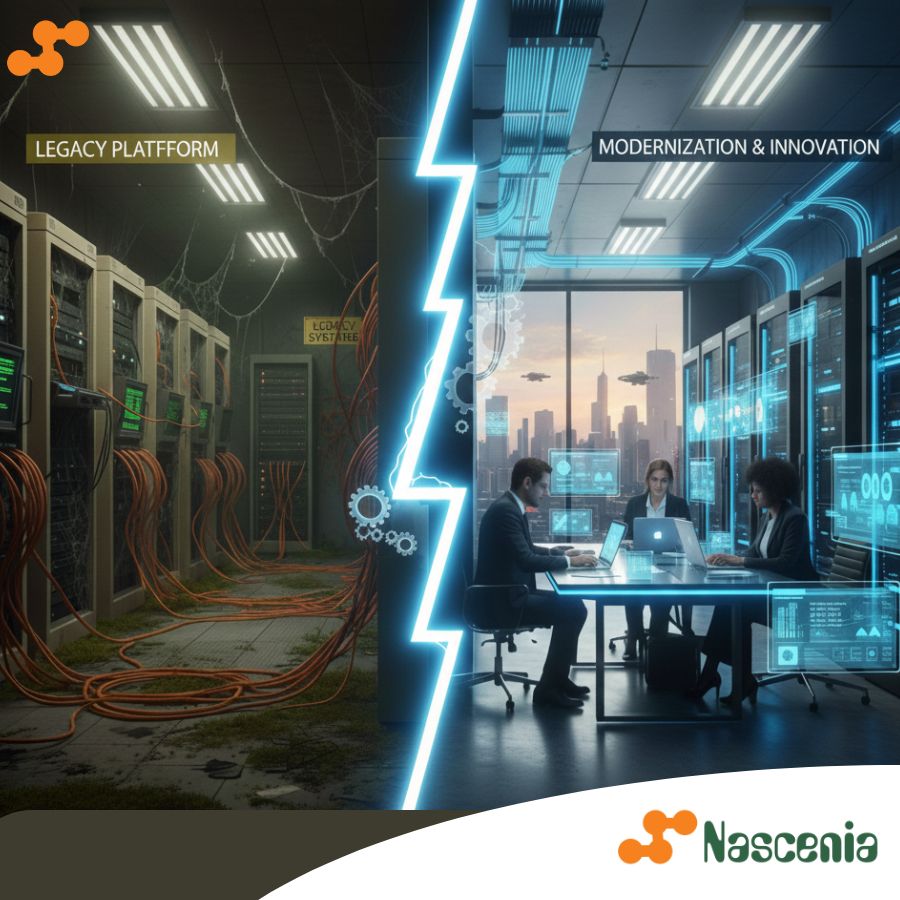
Modern ones often see the creation of highly complex and tightly coupled systems. These are developed using a sequential software development life cycle and contain closely integrated modules based on specific software platforms. Conventional models can be time-consuming, less scalable and possess high costs of maintenance compared to modern models.
Also, conventional ones look at the monolithic architecture, long annual releases, big design up-front, and waterfall ideals. Today’s world of software development is all about agility, microservices etc. Such approaches facilitate a quicker progression, a more extensive scale and also cut the costs down. Also, today’s applications are developed with open-source frameworks and techniques and are deployed on the web respectively for scalability and flexibility.
Factors to Consider Before Developing Enterprise Software
There are some significant things one should consider before developing an enterprise program. If they pay heed to these notable things, then it would be much more beneficial for them in the long run of their trade. The following things are-
Project Goals and End-User Needs
It is important to identify and comprehend the goal of using the enterprise application as critically as possible. Must focus on operations, customer relations and communications. The best way to achieve success is by focusing on understanding the user requirements. Although, surveys may help to understand customers. Then the actual needs of the end-users can be fulfilled after being incorporated into the app. Plus, business evolution and change initiatives are considerable key drivers that an app must be capable of addressing for long-term sustainability.
Cost of Development
Costs are expressed as development costs, which highly depend upon the size and type of the application as well as the selected platform and whether the development is carried out internally or externally. Then again, features, design and testing options should be chosen with more attention. To determine other costs accurately, such as maintenance, building up infrastructure and security or compliance upgrades one has to regard them in the long term.
Time and Development Approach
Development time is measured depending on various factors. Such as the number of developers working, the features of the project and the time of integration of each system. It is important to look at what development approach to choose. Compared to Agile, MVP(minimum viable product) is slower on each input but with more structure. On top of that, quality and development speed are the major concerns in competitive markets since both aspects cannot be achieved at once.
Industry Trends
The use of clouds to support growth in business solutions is a strategic move. It is likely to be very popular in enterprise applications. The routines that have been identified as appropriate fit for AI and automation, including customer relations, service and analytics, are likely to add value to efficiency. Due to the rise of mobile devices, being responsive is the best tactic to target the larger market. Maintaining adherence to legal compliance, including the GDPR and CCPA is crucial. Furthermore, featuring effective measures of data security is critical too.
The Tools & Technologies
Programming Languages- Ruby, Python, PHP, JavaScript, C# etc.
Frameworks & Platforms- jQuery, Angular, .NET, NodeJS, ReactJS etc.
Databases- MySQL, MongoDB, PostgreSQL etc.
Cloud Computing- Amazon Web Services(AWS), Heroku, Microsoft Azure, Google Cloud Platform(GCP) etc.
Integration & Middleware- Ruby on Rails, PHP, .NET, Docker, Jenkins etc.
Advantages
- For Developers and Agencies: EAD presents developers and agencies with a way of engaging in high-risk & high-reward projects. It enables them to utilize current technologies, improve the approach to solving problems and provide solutions tailored to real-life business issues. For that reason, these projects tend to be long-term ones that may enable sustainable client relations.
- For Businesses and Enterprises: These help with enterprise commerce solutions, enrich organizational processes and to work faster and better. Also, it manages the information in a better way. First, these applications enable the streamlining of processes. Second, these enhance the decision-making process through state information. At last, it enhances the business performance.
Challenges
Complexity
Modern enterprise applications are always designed for different types of users. Many of them invite more than one stakeholder and often involve complex processes and workflows. These things make it very difficult to create such applications.
Scalability & Performance
One of the greatest hurdles is that the application needs to be scalable. The amount of data and users will also increase in the future.
Security
Due to the new adamant rules, specifically regarding the collection and usage of personal data, it is crucial to sustain strong security measures. Furthermore, it is also difficult to mitigate susceptibilities associated with the misappropriation, leak or theft of important business data.
Legacy System Integration
Incorporation of new applications into the current workflow is a challenge since it may not be compatible with other business applications. It is usually developed from outmoded technology, or it might contain data that is scattered across various platforms.
User Adoption
One of the major challenges of implementing an information system is ascertaining that users are trained enough to embrace this new system. That should happen, especially if the new system forces them to give up some of their current ways of functioning.
Evolving Requirements
The application will have to change from time to time depending on the growth of the businesses and the ever-changing nature of markets. This calls for flexibility in developing and is also seen to incorporate new features or modifications.
Conclusion
EAD is a strategic center of competitiveness for industries or organizations. It offers specific adaptive procedures that help to improve the work processes, explore the options for improvements and stimulate the ways of further growth. Through the use of available technological solutions such as cloud solutions, automation and the use of scalable solutions can effectively maintain an enterprise’s competitiveness in the current market. It is clear that, despite such difficulties such as complexity, security and scalability, when properly applied the consequences will by far outweigh the difficulties. Try sending an email to Nascenia; our specialists know more about the unique strategies and our expertise team is ready to implement to enhance the usage of enterprise applications. Plus, they’ll help you sustain a competitive advantage in the modern world and will change your enterprise’s operations for the better.
More to Explore
The Quest for Knowledge Continues. Fuel Your Curiosity.