Extended Reality (XR) is an umbrella term for technologies encompassing Augmented Reality (AR), Virtual Reality (VR), and Mixed Reality (MR). XR is used to transform our reality to create immersive experiences and environments with the use of technology. Utilise XR app development services to create interactive apps for your audience at a business scale.
XR tech is not a new concept; the pandemic served as the catalyst to push for more virtual experiences in various industries. From education to training and retail, extended reality applications are altering our daily lives. According to PwC, the global XR market size is expected to reach a staggering amount of $1.5 trillion dollars by 2030.
Read on to understand what XR really is, detailed challenges of app development, benefits of investing, the process and more.
What is Extended Reality – The spectrum
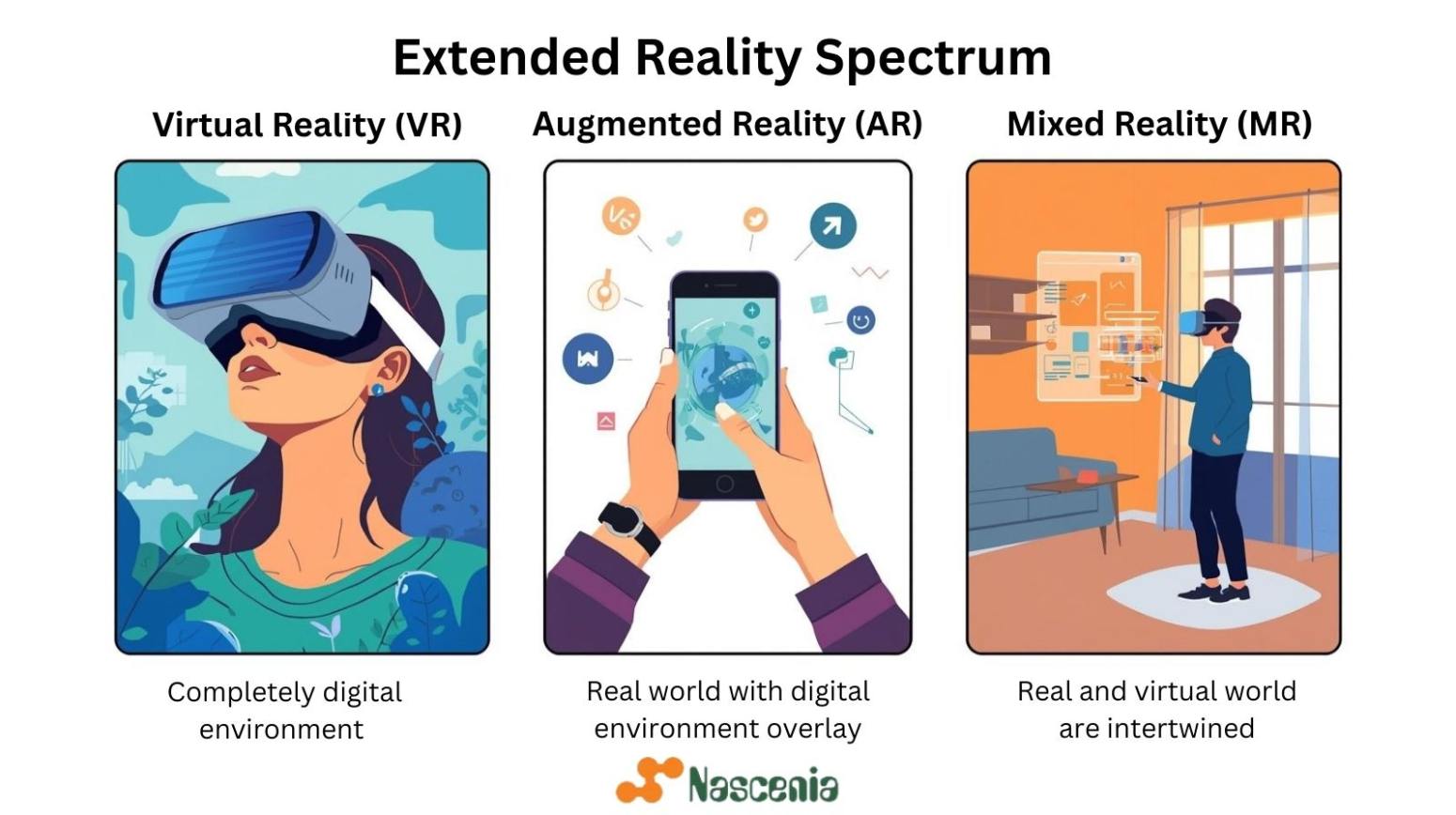
As mentioned, XR immerses the user in the digital environment and is a conglomeration of VR, AR, and MR – though they sound similar, they are made up of unique approaches. Virtual Reality uses computer technology to create a simulated experience that is similar to or completely different from reality. Users are fully immersed in this digital world through the use of a VR headset in a gaming simulation, for instance.
Now with Augmented Reality, digital elements are projected/overlayed onto the physical world through the use of smartphone screens or smart glasses. Essentially, AR falls between reality and virtual reality, as real-world data is rendered in a way that virtual elements resemble the present to an extent. For example, Google Maps shows digital directions on top of real-world locations.
For Mixed Reality it refers to the merging of real and virtual worlds to produce an environment where users can interact with the virtual objects in real-time, unlike in AR. MR does not exist in either the physical or virtual world – it’s a hybrid of the two. More advanced hardware devices are required for this, with see-through cameras and spatial mapping like the Microsoft HoloLens 2.
| Type | Immersion Level | Device Required | User Interaction | Example Use Cases |
|---|---|---|---|---|
| AR (Augmented Reality) | Low-Medium: overlays digital content on the real world |
Smartphone, AR glasses | Touch, gestures, voice | Retail try-ons, navigation, marketing |
| VR (Virtual Reality) | High: fully immersive digital environment, replaces reality |
VR headsets (Quest, Vive, PSVR) | Hand controllers, motion tracking | Gaming, training simulations, virtual tourism |
| MR (Mixed Reality) | Medium-High: real + virtual objects interact in real time |
MR headsets (HoloLens, Magic Leap) | Gestures, gaze, voice, spatial mapping | Collaboration, industrial design, remote assistance |
| XR (Extended Reality) | Umbrella term covering AR, VR, and MR |
Cross-device (mobile, headset, web) | Depends on the platform | Enterprise solutions, metaverse, education |
Why invest in XR App Development?
So why should you step into developing XR apps? Imagine this: your users aren’t just watching your content, they’re actually interacting with it. Extended reality is rapidly revolutionizing industries and driving innovation and efficiency while transforming how teams learn and collaborate.
XR isn’t just a passing trend; it’s a powerful tool to boost your business – whether you’re selling furniture or training employees. The numbers prove it; studies show that companies using XR training can improve learning by 30% – 76% compared to traditional methods. And in retail, brands report up to 11 times higher customer engagement when using AR storefronts compared to static displays.
Implementing XR app development solutions leads to numerous business benefits, such as:
- Cost Savings: You can reduce costs using simulations or virtual prototypes compared to physical mockups and training exercises. Instead of on-site inspections, experts can cut down on travel expenses by inspecting virtually through AR/VR apps.
- Customer engagement: Customers can feel more engaged, for instance, by exploring VR car showrooms compared to just reading flat leaflets. Gives a realistic view of the product before purchasing, which increases customer loyalty in competitive markets.
- Enhanced Productivity: XR solutions enhance team productivity through virtual workspaces, streamlining workflows, hands-free AR headsets, and more. Allows teams to avoid distractions by working in a remote setting that avoids risks and equipment costs.
- Higher Agility: Development cycles can be accelerated by using virtual models, leading to faster return on investment (ROI). New concepts and use cases can be tested and validated before company-wide adoption.
Challenges of Developing a XR App
While the benefits and potential of XR are enormous, the development process itself is a massive undertaking. This is because most organizations don’t have the skillset or experience required to build an XR app in-house. Some of the limitations include:
Technical Requirements
XR apps require powerful hardware to render 3D graphics in real-time to create a convincing immersion for users. The high cost of technology required is not feasible for companies with a limited budget.
The XR ecosystem as a whole is quite fragmented – headsets and SDKs lack proper standards. This affects the adoption of XR technology, which makes it difficult to create an app that works across various systems.
User Health and Safety
Since XR is immersive, developers have to be responsible and account for the comfort and safety of users. There is a risk of adverse physical (tripping) or psychological effects like nausea, eye strain, fatigue, and more.
One of the common causes of motion sickness is due to the low frame rates and the lag between movement and the visual feedback. Long-term use of XR headsets can also cause eye fatigue and discomfort.
High-Quality Content
The XR app you create will be a success depending on the content. However, creating realistic 3D models and their overlays is a time and labour-intensive process. It requires a huge investment in specialized skill sets such as 3D modeling and design. While automation is very useful in this aspect, it still requires a lot of expertise to generate models that are optimised for real-time performance.
Integrating XR
One of the most unique hurdles is integrating XR features into an existing mobile app, compared to building a standalone XR device. Issues like 3D models needing storage space that exceeds the space limits on most apps. Due to these hardware issues, XR features are often limited to high-end devices, limiting the user base.
Not to mention, large assets consume a huge amount of memory, causing older devices to crash. Development teams also struggle with emerging SDKs that add more complexity. A lack of documentation forces developers to rely on trial and error, slowing down the development process.
XR App Development Steps – General Process
-
Defining Project Scope
At the start, all your business goals, objectives, and target audience for the XR app you want to create should be discussed in detail. Along with identifying the best platforms and device ecosystem for the project
-
Design and Prototyping
In this phase, your vision comes to life through an immersive and intuitive user experience. This is done by sketching out interactive elements and prototyping with wireframes.
-
Develop and Integrate
Once the plan is finalised, the latest tools like Unreal Engine XR, ARCore, or WebXR are used to start building. High-quality 3D models, textures, and environments are produced to make your XR experience come to life.
-
Testing and Deployment
Before deployment, rigorous testing must be carried out on your XR application in a real-world environment and on multiple devices. Testing helps address bugs and collect user feedback to further optimize the performance.
Then your app will be deployed to your desired channel – through the app store (Google Play, Apple App Store), enterprise XR solutions, or web-based experience to reach your target audience.
-
Post-Launch Support
Deployment is not the end of the process – ongoing support is needed to support and provide regular updates to your XR product.
Top Tools & Platforms for XR Development
The tech stack is the foundation of XR apps, and choosing the right platform can make or break your project. The top XR development tools are given below.
-
- Development Platform: Unreal Engine, Unity
- Mobile SDKs: ARKit, ARCore
- Cross-platform Framework: Vuforia, MRTK, WebXR
- 3D Graphic Design: Blender, Maya, Adobe Suite
- XR (AR/VR/MR) Devices: HoloLens, Oculus, HTC Vive
Toolkit Comparison Table
| Project Type | Recommended Engine / SDK | Best For | Example Devices |
|---|---|---|---|
| Mobile AR apps | Unity + AR Foundation / ARKit / ARCore | Cross-platform AR experiences | iPhone, Android smartphones |
| High-end VR apps | Unreal Engine XR | Photorealism, immersive simulations | Meta Quest Pro, HTC Vive, Valve Index |
| Marker-based AR (e.g., manuals, marketing) | Vuforia | Object tracking, industry AR | Smartphones, AR glasses |
| Mixed Reality collaboration | MRTK + HoloLens | Enterprise MR, spatial interactions | HoloLens 2, Windows MR devices |
| Browser-based lightweight XR | WebXR / WebAR | No app install, wide accessibility | Any WebXR-enabled browser |
| Quick prototyping | Reality Composer, Blender | Simple AR concepts, early-stage models | iOS, cross-platform export |
How Much Does it Cost to Develop an Extended Reality App?
The cost of developing an extended reality app can depend on various factors. The elements that influence the cost are:
Development Company
The unsaid rule in the industry is that the higher the reputation of the agency, the higher the prices of services. Renowned XR firms hire top-notch experts who provide high-quality solutions. Not everyone has the budget to afford top development firms, so consider outsourcing services from alternative development companies.
Another rule of thumb is that experts from developed countries like Europe or America will have higher prices compared to similar experts from Asian or European regions. Consider partnering with development companies from outsourcing destinations at a fraction of the price.
App Complexity
One of the biggest expenses is the complexity of the app – the more advanced features it requires, the more time is needed to build it. Complex projects need more time and resources due to the functionality and engagement required.
| Complexity | Features | Estimated Cost | Time to Build |
|---|---|---|---|
| Simple | Basic AR filters, simple 3D model viewing | $10,000 – $30,000 | 3-5 weeks |
| Moderate | Basic UI interactions, VR training models, animations | $30,000 – $150,000 | 4-6 months |
| Highly Complex | Mutilplayer mode, AI interactions, interactive UI | $150,000+ | 12+ months or more |
Platform Compatibility
Ideally, you want to develop an app supported by multiple platforms like iOS, Android, but costs can vary as each platform has its own guidelines. Multiple platforms need more testing and optimization – the best option is to start with specific platforms to keep development costs low.
- Mobile Devices: $3,000 – $15,000
- Standalone: $15,000 – $50,000
- PC-tethered: $30,000 – $100,000+
- Web-based: $15,000 – $45,000+
Content Development
For the XR experience, creating quality content is essential to provide a rich user experience. 3D models bring new life to virtual worlds, though the cost can add up depending on the level of detail. Animations, on the other hand, provide movement, while audio/visual effects (VFX) increase the user’s immersion level.
3D Models: $1,000 – $5,000
Animation: $1,000 – $10,000
Audio.Visual effects: $500 – $2,500
Real-Life Applications of Extended Reality
Gaming and Entertainment
Want to explore realistic worlds that come straight out of science fiction? Well, with XR technology, users can experience live music, movies, and sporting events from the comfort of their own homes using headsets. As more game developers launch new headsets, this opens the door to more innovation in the entertainment industry.
Engeering & Manufacturing
XR tools can aid in industries that involve dangerous elements. For instance, simulations help employees learn to use risky equipment, and robots conduct tasks involving hazardous materials. XR tech can also be used to overlay digital instructions directly onto machinery that guides employees through complex tasks. Not only does XR help save money and time, but it also trains the workforce to become more skilled.
E-commerce and Retail
XR solutions can revolutionize the shopping experience both online and offline – like trying on clothes without using the fitting room, testing lipstick shades without using the tester, etc.
In e-commerce, AR tech allows users to test the product in an augmented world before purchasing. Product returns can cost nearly $890 billion per year, and AR helps reduce the return rates of companies by a wide margin.
Education
Students get to explore beyond the traditional learning methods – walking through ancient Greece, floating in outer space, and conducting virtual lab experiments. The rich multisensory experience of VR learning can boost memory retention up to 80% and further learning outcomes. Schools and universities can benefit from XR at all levels in the education system, and also be applied to professional learning.
Healthcare
XR technology contributes immensely to healthcare, including mental well-being, educational training, remote care, and more. One of the benefits lies in surgical training, where immersive models provide hands-on experience to doctors without putting lives at risk. Also beneficial in patient care, where medical staff use AR to make informed decisions.
Real Estate
In real estate, XR is more than just virtual tours; imagine changing the furniture, the colour of the walls, or even the flooring, all in real-time. XR development gives clients an immersive experience in visualizing their dream home. Real estate agents are already utilising XR functions with current tools to give prospective buyers virtual tours of properties from a remote setting.
Future XR Trends
- Metaverse and Social XR: The concept of metaverse, shared 3D virtual worlds, relies on XR. Businesses will explore metaverses for collaboration, onboarding, and more. Apps can be expected to focus on social XR experiences to bridge the physical and digital communities.
- Hardware Advancements: A critical challenge of XR adoption is the bulky, costly XR headsets. With advancements in technology, lighter, cost-effective headsets can be produced that prioritise user comfort. Mainstream XR adoption will increase when XR devices are as common as modern-day smartphones.
- AI Integration in XR: Artificial intelligence and gen AI will play a major role in making XR apps more context-aware. Spatial computing will make interactions more intuitive, while AI-driven object recognition will allow AR systems to understand environments better. AI will also drive the creation of more realistic avatars and enable NLP for intelligent agents within VR/AR.
- Haptic Feedback: More than just simple vibrations, wearable haptic devices, such as gloves, simulate a range of sensations to enhance the realistic experience. New technology uses ultrasound waves to create tactile sensations in mid-air, allowing users to interact with virtual objects without actually touching them.
- Connectivity: Hybrid edge computing and cloud rendering will be utilized more compared to local hardware to untether XR devices. To stream high-fidelity content, 5G and Wifi 6 will enable the use of ultra-low latency connections. And in industrial settings, XR will merge with Internet of Things (IoT) and digital twin technology to create immersive simulations. Immersive content will also be more widely accessible through web browsers thanks to WebXR.
Conclusion
Extended Reality represents the shift in how we interact with the world around us. The benefits of XR are endless, from fully immersive digital worlds to digital overlays – XR applications are proving their value across a wide range of sectors.
However, the path to developing an XR app is fraught with challenges. Developing a successful XR app requires a proper strategy, and by following a structured development process, organizations can unlock the full potential. As XR solutions continue to increase, companies that invest in XR app development will gain an edge over competitors.
More to Explore
The Quest for Knowledge Continues. Fuel Your Curiosity.